Monday, April 7, 2014


Thursday, April 3, 2014
THE FOUR SUPREME ACQUISITIONS
THE FOUR SUPREME
ACQUISITIONS
“Arogyaparama labha
santhutthiparamam danam
Vissasaparama nati nibbanam
paramam sukham.”
 "Health’s the greatest gain,
Contentment, best of wealth
Trusting’s best of kin,
Nibbana bliss supreme."
The Story of King Pasenadi of
Kosala (Dhammapada Verse – 204)
While residing at the Jetavana Monastery,
the Buddha spoke this verse, with reference to king Pasenadi of Kosala.
For at
a certain period of his life King Pasenadi Kosala used to eat boiled rice
cooked by the bucketful, and sauce and curry in proportion. One day after he
had eaten his breakfast, unable to shake off the drowsiness occasioned by over
eating, he went to see the Buddha and paced back and forth before him with a
very weary appearance. Overcome with a desire to sleep, but not wanting to lie
down and stretch him-self out, he sat down on one side.
Thereupon the Buddha said to him, “did you
come, great King, before you were well rested?” “Oh no, Venerable, but I always
suffer greatly after eating a meal.” “Then said the Buddha to him, “Great King,
over - eating brings much suffering.” So saying, the Buddha gave the following
stanza:
If a man gives a way to indolence, eats
much, spends his time in sleep, and lies and rolls about like a great hog fed
on grain, such a simpleton will endlessly be reborn.” After admonishing the
king with this stanza, the Buddha continued, “Great King, one ought to observe
moderation of eating, for in moderate eating there is comfort. And admonishing
him further, the Buddha gave the following stanza:

“If a man be ever mindful, if he observe
in moderation in taking food, his suffering will be but slight; he will grow
old slowly, preserving his life.” The King was unable to memorize this stanza.
So the Buddha said to the Kin’s nephew, Prince Sudassana, who stood near,
“Memorize this stanza.” Sudhassana asked the Buddha, “Venerable, after I have
memorised this stanza, what shall I do with it?” The Buddha replied, “When the
king eats his meal, just as he about to take the last lump of boiled rice, you
must recite this stanza. The King will understand its purport and will
immediately throw a way that lump of rice. When it is time to boil the rice for
the King’s next meal, you must fetch just as many grains of fresh rice as there
and grains of boiled rice in that lump
rice.”
“Very well, Venerable, “replied Sudassana.
So both evening and morning, when the King eats his meal, his nephew would
recite the stanza just as the King was about to take the last lump of boiled
rice, and would fetch for his next meal just as many grains of fresh rice as
there were grains of boiled rice in the lump of boiled rice which the King had
thrown away. And every time the King heard that stanza recited, he gave away a
thousand pieces of money in alms. The King contented himself with a pint-pot of
boiled rice a day, never exceeding that amount. After a time he became cheerful
and lean.

One day the King went to pay his respects
to the Buddha and having saluted the Buddha, said to him, “Venerable, now I am
happy. Once more I am able to follow the chase and to
catch with beasts and horses. I used to quarrel with my nephew. But recently, however,
I gave my nephew my daughter, the Princess Vajira, to wife. I have given her
this village, that she may have a pool wherein to bathe. My quarrels with my
nephew have ceased, and for this reason also I am happy. The other day a
precious stone, the property of royal household was lost; this has but recently
returned to my hand, and for this reason also I am happy.”
“The Buddha replied, Great
King, health is the greatest blessing one can ask for, contentment with whatever
one has received is the greatest wealth, confidence the best relative. But
there is no happiness that can be
compared with Nibbana.”

Of acquisitions, good health is the
foremost. Of wealth, the greatest is peace of mind. Of kinsmen, the trustworthy
are the Supremes’. The highest bliss is Nibbana.
Vissa
parama natti:
The trustworthy are the greatest
relatives. Relatives are generally the most trusted. Relationship stands in the
foundation of trust. The traditional commentary has this to say:
“Mata va hotu pita va tena
saddhim vissaso natthi, yena annatakena pana saddhim vissaso atthi so
asambandhopi paromo uttmo nati.”
“if
one has no trust even in one’s mother, father or other relatives, they are not
relatives in reality. But on the other hand, if one can place one’s trust in someone who may not be
related, he is truly a great relation. Trust implies agreement, intimacy, and
confident. As it is difficult at times to fathom the motives of some people
and, as some are vicious, trust place in those types of person – whether
related or unrelated – is likely to bring about evil results on one. This way
it is difficult to come upon a person who could be implicitly trusted. Good
results ensure from true and genuine trust. There are three things that are
conducive to one’s downfall.:
“Loba paramada visvasana
purusho nashayate thribhi: tasma lobo nakartavyam pramado navishvaset.”
The three things that bring about man’s
downfall are miserliness, slothfulness and wrong trust.
Monday, March 31, 2014
THE BUDDHA'S GREAT DISCIPLE, UPPALAWANNA MAHA ARAHAT THERI
THE STORY OF VENERABLE UPPALAWANNA MAHA
ARAHAT THERI


 When the
Arahat Bhikkhuni Uppalawanna was raped by a kinsman of hers the monks began
wondering whether Arahats are susceptible to sensual pleasures. It was said, “To
be sure those that have rid themselves of the depravities gratify their
passions. Why should they not? For they are not Kolapa trees or ant-hills, but
are living creatures with bodies of moist flesh. Therefore they also like the
pleasures of love.”

 The Story
of Arahat Uppalawanna Maha Theri


Just as the Buddha had appointed two chief
disciples in the order of monks, Venerable Maha Arahat Sariputta Thero and Venerable Maha Arahat Moggallana Thero, Buddha likewise named two women his foremost disciples in the
Bhikkhuni Sanga, the order of nuns. These two were the Bhikkhunis, Venerable Uppalawanna Maha Arhat
Theri and Venerable Maha Arahat Khema Theri the former excelling in psychic
power, the latter in wisdom (AN1, chap14).


The Story
of Arahat Uppalawanna Maha Theri

Dhammapada
Verse 401
“Like water
on a lotus leaf, or mustard seed on needle point,
Who so
clings not to sensual things, that one I call a Brahmin True.”
This
religious instruction was given by the Buddha while the Buddha was in residence
at Jetawana with reference to Arahat Bhikkhuni Uppalawanna. The story has been
related at length in the Commentary beginning with the words, ”As sweet as honey
thinks a fool an evil deed,” For it is there said:
When the
Arahat Bhikkhuni Uppalawanna was raped by a kinsman of hers the monks began
wondering whether Arahats are susceptible to sensual pleasures. It was said, “To
be sure those that have rid themselves of the depravities gratify their
passions. Why should they not? For they are not Kolapa trees or ant-hills, but
are living creatures with bodies of moist flesh. Therefore they also like the
pleasures of love.”
At that
moment the Buddha drew near and after hearing this the Buddha said,” No monks,
they that have rid themselves of the depravities neither like the pleasures of
love nor gratify their passions. For even as a drop of water which has fallen
upon a lotus-leaf does not cling thereto or remain thereon, but rolls over and
falls off, even as a grain of mustard- seed does not cling to the point of a
needle or remain thereon, but rolls over and falls off, precisely so two- fold
love clings not to the heart of one that has rid himself /herself of the depravities
or remain there.” And Buddha, joining the connection, preached the Dhamma with
the above stanza.
The Story
of Arahat Uppalawanna Maha Theri
Uppalawanna,
the other Chief disciple of the Buddha, was a very beautiful young Princess.
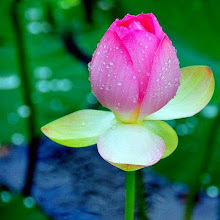
She was named after the “blue lotus” flower—Uppala - Vanna, Uppalawanna, because
of her beautiful complexion.
Uppalawanna was born in a wealthy family and when
she came of age, proposals for marriage came from all quarters. Many princes
were interested in marrying her and came to take her hand. But the parents
found it too difficult to decide on which one. The harassed father did not wish
to offend any suitor by a refusal. To the
father, ordination in the Noble Sangha was the only solution. They, with
the consent of Uthpalawanna, decided to ordain her as a nun. The daughter, true
to her destiny, agreed. She became the
highest Bikkuni amongst all who perform Miracles using the astral body.
Upon being
ordained, she was kept in charge of the convocation room where the nuns
assembled for the confession of lapses. She had to tend the lamps. She observed
that the light was sustained by the wick and the oil. Sometimes, the light goes
out by going short of either or by a gust of wind. So life was due to karmic
force. This kept her thinking till she became an Arahat. She remembered her
former past lives.
It was while
living alone in a forest, a young shepherd named Nanda, kinsman of hers, got
infatuated with her and committed a sexual offence as soon as she returned from
a round of alms. Coming from the noon day glare to the dark cave where her
abode was, she could not see hence, she was taken by surprise despite her
protests. He committed the dire deed and was immediately born in the hell (niraya)
when the earth yawned and swallowed the foolish young man. He was however, dead
before the yawning of the earth.
It was after
this incident the Blessed One prohibited the female disciples of the Noble
Sanga to live in isolation in the forest.
Not long
afterwards, the Buddha addressing the monks, declared Arahat
Uppalawanna Maha Theri, foremost for
psychic power who performs miracles using the astral body.
The Buddha has held up these two as
the models and examples for all the nuns to emulate, the standard against which
other nuns could evaluate themselves. (SN17:24)
Subscribe to:
Posts (Atom)